Structural drying that finishes on a timeline, not when the instruments confirm it, leads to mold behind walls and the callbacks that follow. Our Haskell drying crew completes the program when the readings say it's done — not before.
Structural Drying is a science-driven process built on thermodynamics, psychrometrics, and equipment calibration — not fans pointed at a wet floor and checked weekly. Here's what our Haskell team brings to every structural drying project that ensures complete, documented results.
Low-grain refrigerant (LGR) dehumidifiers operate more efficiently in the low-humidity conditions created by an active drying program than conventional dehumidifiers — achieving lower dewpoint conditions that accelerate evaporation from structural materials. Our Haskell structural drying crews deploy properly sized LGR equipment based on the specific volume and material profile of your affected assemblies. Equipment sizing is calculated, not estimated.
Every active drying project in Haskell receives a daily psychrometric reading session: temperature, relative humidity, specific humidity, grains per pound of moisture in the air, and moisture content readings at fixed sensor points in each structural assembly. These readings are logged and provided as documentation of the drying program for your insurance claim. Drying is declared complete only when readings at all sensor points fall within the target EMC range for the material species being dried.
Wall cavity drying is where most post-loss mold in Haskell properties originates. It's where we focus.
Insurance-formatted drying documentation means faster settlement and fewer adjuster callbacks.
COS Water Damage Restoration's Haskell structural drying service covers every assembly type and situation encountered in a water damage event — from standard floor and wall assemblies to hardwood systems, crawlspace framing, and multi-story moisture migration events.
The most common drying failure in Haskell water damage projects is a wall framing cavity left with elevated moisture content after surface materials are dry. Our Haskell team uses calibrated cavity access — typically 1-inch drill holes at the base of the wall framing cavity — to introduce directed airflow from high-velocity air movers into the stud bay, paired with LGR dehumidification to extract the evaporated moisture. Moisture readings at framing sensor points confirm completion. Access ports are patched and filled after the program completes, typically leaving no visible trace of the access procedure.
Subfloor and hardwood drying in Haskell is species-specific and requires daily monitoring of cupping and moisture gradient.
Crawlspace saturation after a water event in Haskell often goes undetected — we include it in every below-grade moisture mapping session.
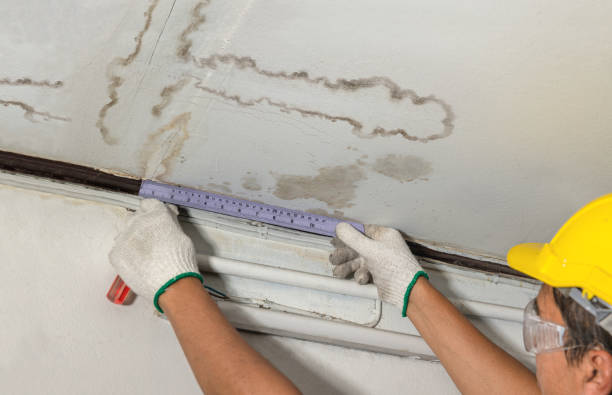
Ceiling assembly drying is one of the more technically demanding aspects of water damage restoration in Haskell structures.
Large water events in Haskell commercial or multi-family properties may affect dozens of rooms across multiple floors — requiring coordinated equipment staging, airflow balancing between spaces, and readings management across a large number of sensor points simultaneously. Our Haskell commercial drying team uses scaled equipment deployment and a project management approach that tracks readings and equipment across the full property footprint, adjusting equipment placement and settings daily based on the reading data from each zone.
Every active structural drying program in Haskell is also a mold prevention program — because the conditions that support mold growth (elevated moisture content in organic materials and elevated relative humidity in the air space) are exactly the conditions a drying program is designed to eliminate. Our daily reading sessions include assessment of the ambient RH and temperature conditions in each drying zone against the threshold conditions that support mold colonization. If readings suggest an elevated mold risk — particularly in projects where extraction was delayed — we address it proactively with targeted antimicrobial treatment during the active drying program.

Equipment before mapping is guesswork. Mapping before equipment is science.
Equipment placement is engineered based on the moisture map and assembly data — not placed by habit.
Daily readings, daily reporting, daily equipment adjustment if needed — documented throughout.
When all sensor point readings fall within the target equilibrium moisture content range for the specific materials being dried, we perform a final comprehensive moisture survey of the entire affected area and issue a written drying completion report. This report is included in your insurance claim documentation and serves as your record of successful structural drying.


"The most important thing about COS Water Damage Restoration's Haskell structural drying was that they explained the readings to me every single day. I understood what the numbers meant, what the target was, and how far we were from completion. By day six I was watching the moisture content readings in our wall framing drop from 28% to 11% and understood exactly what was happening and why. That level of transparency is what you need when your home is full of drying equipment for a week."
"The thermal imaging session at the beginning was what showed us the water had migrated into a wall cavity adjacent to the flooded room that we never would have found otherwise. COS Water Damage Restoration set up wall cavity drying for that section specifically, and the final readings confirmed it came out completely dry alongside everything else. That's the kind of detail that prevents the mold problem three months later."
"We had a particularly complex drying project across three floors of a Haskell office building after an upstairs pipe event. COS Water Damage Restoration managed the zone readings, adjusted equipment as the drying progressed on different floors at different rates, and wrapped the entire building within 11 days with full documentation. That's professional-grade project management."
COS Water Damage Restoration's Haskell structural drying team serves Haskell and surrounding communities throughout NJ. Daily monitoring included. Call +1-844-499-0972 to get started.
Don't let wet wall cavities become next month's mold problem. Call +1-844-499-0972 and get Haskell's certified structural drying team on site.
📞 Call +1-844-499-0972 — Haskell Structural Drying24/7 Available · IICRC WRT Certified · Daily Readings · Haskell, NJ